Showing posts with label Japanese Tattoos. Show all posts

Japanese Dragon Tattoo Meanings

The Japanese dragon is one of the most popular mythological creatures picked for inking and a classic choice for a tattoo design. It is usually depicted as a wingless, heavily-scaled snake-like creature with small clawed legs and a horned or antlered camel head, and is associated with sea, clouds or the heavens.

Dragon Japanese TattooDragon Japanese Tattoo

Japanese dragons tend to be much more slender and fly less frequently than the Chinese counterparts. The breath of the Japanese Dragon changes into clouds from which come either rain or fire. It is able to expand or contract its body, and in addition it has the power of transformation and invisibility. This is merely a general description and does not apply to all Japanese dragons, some of which have heads of so extraordinary a kind that they cannot be compared with anything in the animal kingdom.

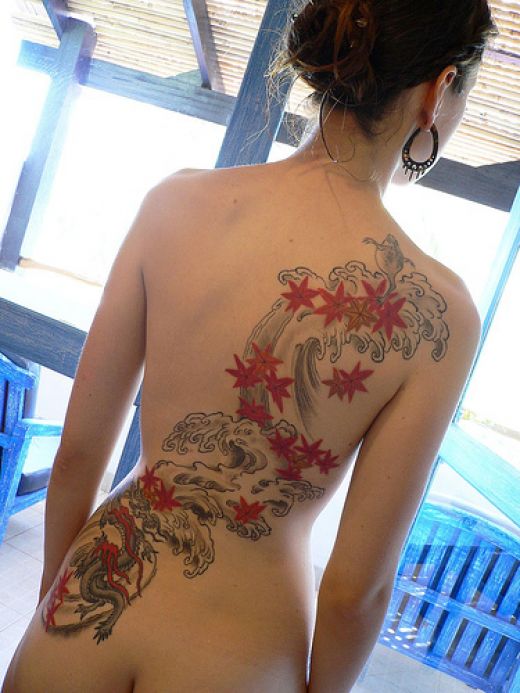
Sexy Girl Dragon Japanese TattoosSexy Girl Dragon Japanese Tattoos

According to most sources, the Japanese dragon is closely related to the Chinese counterparts, with the exception that the Japanese dragon has only three claws, while that of the Celestial Kingdom (China) has five. Tattoo artists have taken the art of the Japanese dragon to amazing new levels. Whether you want a full back design or a half sleeve design, you will find an incredible gallery of amazing designs to choose from. They can be in color, or black & white. The dragon tattoo may appear with sea wave or clouds or pearls.

Lower Dragon Japanese TattoosLower Dragon Japanese Tattoos

If the dragon claw holds an enormous magical pearl, which has the power to multiply whatever it touches, the “pearl” symbolized the most precious treasure: Wisdom. Ancient Dragon lore and illustrations have inspired many of us to select a dragon tattoo because that design represents how we feel about ourselves — strength, wisdom and freedom…

The popular locations for inking Japanese dragon tattoos.

Dragon Japanese TattoosDragon Japanese Tattoos

Japanese dragon tattoos can wrap around the body and flatter the contours of the body, full body and full back dragon tattoos are quite common, and the most popular location is half sleeve, the body of the dragon wrap around the upper arm and the dragon head extend out the upper front, just above the heart. Because of the long shape of the dragon, it also suited for inking on arms and legs.

Where to Find Perfect Japanese dragon tattoo designs for Inking?

Dragon Japanese Tattoos on Body BackDragon Japanese Tattoos on Body Back

After all, getting an awesome Japanese dragon tattoo that perfectly flows with your body is what makes you feel proud. Am I right? There are many good reasons to get an awesome Japanese tattoo and there are many ways to screw it up. The most important thing to find a perfect Japanese tattoo is to take your time browsing through numerous tattoo collections before you settle the one for inking. The Japanese dragon is one of the most popular mythological creatures picked for inking and a classic choice for a tattoo design. It is usually depicted as a wingless, heavily-scaled snake-like creature with small clawed legs and a horned or antlered camel head, and is associated with sea, clouds or the heavens.

Japanese Dragon Tattoo Designs

Japanese Dragon Tattoo DesignsJapanese dragons are a combination of Indian, Chinese and Korean myths and legends, both in their appearance and their significance. They are primarily understood as manifestations of water gods, whether the water is rain, a river, or the sea. Japanese dragons are different than European dragons mostly due to their lack of wings, though they share the same long, snakelike bodies of the dragons from European lore.

Japanese Dragon Tattoo DesignsYou can tell whether a dragon is Japanese, Chinese or Korean by how many toes it has on its feet. Chinese dragons have five toes, whereas Korean ones have four toes and Japanese dragons have only three toes. In Chinese mythology dragons represent wisdom and power. There are nine kinds of Chinese dragons, and each has a domain or a characteristic assigned to it -- there are celestial, spiritual, earth, underworld, horned, winged, coiling and yellow dragons, and the king.

Japanese Dragon Tattoo DesignsJapanese dragons mean different things to different people, and tattoo culture in the modern United States seems to be morphing away from what dragons represented in traditional Japanese texts, like the Kojiki and Nihongi that were written all the way back in 7th and 8th century Japan and earlier. For instance, in modern tattoo parlors, the dragon Ryu is a Buddhist image of faith, and is considered an immortal.

Japanese Dragon Tattoo DesignsThere is a dragon god Ryujin, also called Watatsumi in ancient Japanese myths, but he was not so much an embodiment of faith so much as the ruler of the oceans. He was also able to change into human form when he chose to, and there are no references in modern tattoo lore or meanings or artist's renderings of these creatures becoming human.

Japanese Dragon Tattoo DesignsDragon colors are very important for the meaning of a tattoo. Dragons in this tradition come in black, red, white, blue and yellow. The colors are tied to one of the four directions (North, South, East and West), and to the behaviors of the dragon. Black dragons represent the North, for example, and create storms when they fight. Red dragons also create storms when they fight, but they represent the West. Blue dragons hail from the East and are a manifestation of the season Spring. White dragons belong to the South, and represent mourning, death or famine and the eastern dragon god O Goncho. Yellow dragons are actually meant to be gold dragons and represent the dragon Kinryu. They are linked to no particular direction and are almost always invisible, until the single perfect moment, in which they briefly show themselves.

Japanese Dragon Tattoo DesignsThere are also a number of names and qualities embodied with different dragon tattoos now. For example, the dragon Fuku Riu is for good luck. He is usually shown flying up and is supposed to be in a pose of liveliness and strength. According to our dragon lore, any dragon flying into the sky mean ascension or success.

Popular Japanese Tattoo Meanings, Symbolism and Designs

Japanese TattooThere has been a phenomenal growth of traditional Japanese tattoo designs in the past few years. It used to be that tattoos were relegated to the Yakuza or Japanese gangs and the criminals in the society. Just the site of a tattoo used to and still can strike fear into people. However, Japan is a rapidly changing country and they are starting to see the value in tattoos and more and more people have a deep respect for them. For most tattoo artists and tattoo enthusiasts alike Japanese designs have always been sought after. Here are some Japanese tattoo meanings and design ideas to help give you a guide of some possibilities if you are interested in getting such a design.

Cherry Blossom Tattoo
Cherry Blossom TattooFor the Japanese the cherry blossom is seen to represent life itself. The flower is a thing of great beauty. It is strong in that is pushes itself and blooms in harsh conditions and climates and often comes out when the snow is first melting. Yet it is paradoxically fragile at the same time. It is fragile because it will only last a few days and then it will fall from the tree and land in the snow. The Japanese view this as a representation of life itself. Life should be lived to extreme beauty and everyday should be lived to it’s fullest. Yet one must always be aware of the possibility of death and therefore with the eventuality of death live life even more fully. This is a great tattoo and a symbol that is laden with powerful reminders and a great guide to how each individual should live their life.

Koi Fish Tattoo
Koi Fish TattooKoi fish are probably the second most powerful symbol in tattoo designs in general but also fro the Japanese. Koi fish can been seen in front of almost every temple throughout Japan. The myth states that the Koi fish swim back up stream against the current to eventually read a bridge or a gate. If they can make it to the gate they are turned into dragons and magically fly away to start a new life. The symbolism behind this design is one of perseverance which is a very deep and important concept for the Japanese. In fact they have many more words to describe perseverance, effort and sticking with something in the language then we do in English.

Hannya Mask Tattoo
Hannya Mask TattooHannya masks are scary looking and demonic masks. The mask comes from the famous Kabuki plays in Japan and it depicts a women who has been consumed with rage over a lover or someone that has not returned her love. There are different variations as each Kabuki play has a different interpretation. At any rate these masks represent a jealous women. However, they have been widely used in Japanese tattoos and also here in the west. When they are used in tattoo in it is believed that they will ward of evil spirits and bring good luck to the person wearing it. Japanese will also sometimes but these up for display high in the room of their house to ward off evil spirits.

Samurai Tattoo
Samurai TattooSamurai of course lived by the code of Bushido. There is not enough room here to full explain the code of Bushido but it deals with living life to the fullest, being prepared to die in service and being loyal and strong. The concepts of Bushido are pretty much at the heart of all Japanese values and morals and also what is taught to most young kids over and over again through stories. You could say the code of Bushido is the heart of the Japanese culture and beliefs. Samurai’s and samurai tattoos of course are the best symbol of these beliefs.

These are just four of the most popular themes within Japanese tattoos. One of these might be right for your design and what you are looking for. There are tons of other Japanese tattoo meanings and tattoo design out there. It is best to do some reaserch and spend time finding a design that is right for. This site dedicated to Tattoo Designs can be very helpful in finding the design that is right for you.

Japanese Tattoos - A Brief History

The traditional Japanese tattoos known as 'horimono' became very popular among the people of the 18th century or the Edo period. The most popular choices for the designs of the tattoos were the images from traditional water color paintings, picture books and woodcuts. Understanding the history and background is as important to experience and enjoy the Japanese horimono tattoos as it is to preserve their traditions. The Edo period was like a period of Cultural Revolution for the Japanese. There were many changes that happened during that period at different levels of the society. A different class of people grew up out of the ordinary people of Japan, who found lot of interests in fashion, comedy, drama, novels, songs, and theatre. So, a unique and separate culture began to grow up.

Japanese Tattoos
As the society of Edo progressed, the ordinary people began to take pride in activities of fashion. Gradually, the Edo working class people began to imitate the heroes from the folk stories they used to read in the books (especially the picture books) and comics and other artworks as popularized by the famous woodblock artist Kuniyoshi. Getting highly impressed from these artistic works, the people began to tattoo themselves ritualistically and painfully with the designs based on folklore, such as dragons, Chinese lions, and giant snakes, and also with religious figures with the help of sharp needles for inserting pressed charcoal ink under their skin.

Japanese Tattoos
The people who carried out the process of tattooing were mostly the woodblock artists who simply had to exchange their wood-carving blades for long and sharp needles. With time, some of these people became so much involved with tattooing that common people began to accept them as tattoo specialists. This is how the unique Japanese traditional body art form, horimono was formed.

Today, it is very common to have tattoo conventions in Japan as well as in the West. But to have such conventions in the Edo period in Japan around 150 years earlier is itself a strong indicator of the Japanese having a long and rich history of tattoo culture. Even though there are no photographic record of their works and designs, lot of books are available today which describe the life and work of many tattoo artists of the Japanese Edo period.

Japanese Tattoos
One very famous tattooist from the Edo period is Horiuno. Horiuno was born in 1843. He became a tattooist at the age of 20. But before beginning to work full time from his age of 40, he travelled extensively throughout Japan, going from place to place like Osaka, Kyoto and Shizuoka. However, he continued doing his business well into his seventies and much of his work can be seen even today. Most of his customers used to work in the local construction and manufacturing industries, and in 1912, some of these people of the Kanda area formed the Kanda Choyu-kai, meaning "Tattoo Friends Society of Kanda", and after another 10 years, the society was extended to outside the Kanda area, and formed the Edo Choyu-kai.

Japanese Tattoos
All the members of this group, who are mostly labourers such as construction workers, carpenters and plasterers, meet every year at places like Ojinanushi-no-taki and Marukotamagawaen, take part in mass outdoor banquets, or in festivals such as the Asakusa Sanja-matsuri, and present their intricate and extensive body art tattoos with pride. Horiuno was known as the most talented tattooist from Japan and was famous throughout Japan and also overseas. However, at that time there were many other equally skilful tattooists in Japan, such as Horikane, Kyuta, Horiiwa, and Nekokichi.

Japanese Tattoos
If you have grown tired of your tattoo and want to have it removed there are a number of options available, home and DIY methods have worked for people but the highest success rate comes with surgical methods. To remove a tattoo with excision can be costly but it's far less painful with a greater success rate. Take a look at the effect of tattoo excision.


Article By: Robert T Jones

Koi Japanese Style Tattoo

Koi Japanese Style TattooKoi Japanese Style Tattoo

Japanese Style Tattoo In Hand

Japanese Style Tattoo In HandJapanese Style Tattoo In Hand

Japanese Style Tattoo

Japanese Style TattooJapanese Style Tattoo

Koi Japanese Style Tattoo

Koi Japanese Style TattooKoi Japanese Style Tattoo

Dragon Tattoo

Dragon TattooDragon Tattoo

Dragon Tattoo

Dragon TattooDragon Tattoo

Geisha Japanese Style Tattoo

Geisha Japanese Style TattooGeisha Japanese Style Tattoo